
All the Talk About Psychological Safety — Yet Silence Persists
You can run all the psychological safety workshops you like. If the culture underneath punishes honesty, nothing changes. Here’s the conversation most organisations are still avoiding.
Steve Simpson
2/13/20264 min read

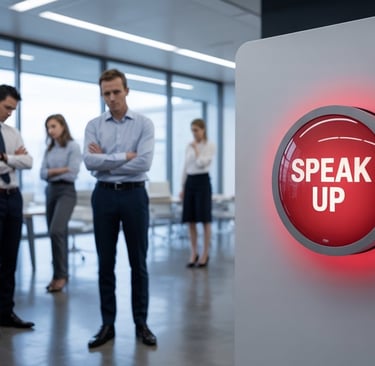
Psychological safety is having a moment.
You see it everywhere — leadership conferences, board agendas, regulatory guidance, culture surveys, and a constant stream of LinkedIn commentary about “creating safe spaces.”
On the surface, it sounds encouraging. For years, employees have held back concerns, swallowed risks, and stayed silent when they should have spoken up. So the increased focus on psychological safety is, in principle, a good thing.
But here’s the uncomfortable truth.
For all the language, many workplaces still struggle to get people to speak up. People hesitate before challenging decisions. Bad news travels slowly. Mistakes get quietly buried. Risk is filtered on its way up the line.
Which raises an obvious question: if psychological safety is now such a priority, why is silence still so common?
The Implementation Illusion
Most organisations are approaching psychological safety the way they approach any other initiative. They run workshops, train leaders in “safe conversations,” promote speak-up campaigns, create reporting channels, and publish commitments about openness and transparency.
All well-intentioned. All visible.
But much of this operates at the level of messaging and skill-building rather than at the level that actually determines behaviour.
Employees don’t decide whether it’s safe to speak up based on what leaders say in workshops. They decide based on what they see happen in real moments — how leaders react when challenged, what happens to people who raise inconvenient truths, and whose careers advance or stall after doing so.
Over time, people draw conclusions not from policy, but from pattern.
Declared Safety vs Experienced Safety
This is where the gap opens up.
Leaders declare psychological safety. Employees test it.
A leader invites challenge in a meeting, then shuts it down when time pressure hits. Mistakes are framed as learning opportunities until they affect performance metrics. Speaking up is encouraged, but those who do it too often are quietly labelled “difficult.”
None of this is usually deliberate. Most leaders genuinely believe they are supportive of openness.
But culture isn’t shaped by intent. It’s shaped by reaction — especially under pressure. And those reactions create unwritten rules about what is truly safe.
The Missing Mechanism: UGRs
This is the piece that receives only cursory attention in most psychological safety conversations — the unwritten rules that sit underneath the rhetoric.
UGRs — Unwritten Ground Rules — are people’s perceptions of “this is the way we do things around here.” They form quietly through observation and shared experience.
In the context of psychological safety, they sound like this:
Around here, challenging senior leaders is risky.
Around here, bad news is softened before it travels upward.
Around here, mistakes depend on who made them.
Around here, raising concerns can stall your career.
Around here, it’s safer to stay quiet unless you’re certain.
No organisation writes these rules down, but they are learned quickly. Once embedded, they overpower any workshop message about speaking up.
Psychological safety lives or dies in these perceptions — not in training content.
Why Culture Gets Only Cursory Attention
If UGRs are so central, why do organisations focus more on psychological safety programs than on the culture beneath them?
Partly because culture is harder to see. UGRs aren’t documented; they sit in patterns, reactions, and consequences. That makes them harder to diagnose and harder to discuss.
It’s also because culture implicates leadership behaviour directly. Psychological safety training can be delegated to HR or Learning & Development. UGRs point to how leaders behave when challenged, stretched, or under delivery pressure.
There’s also comfort in measurement. Surveying whether people feel safe is less confronting than examining why they don’t. And finally, programs feel faster. Running workshops creates visible action, whereas shifting unwritten norms requires sustained behavioural alignment.
In blunt terms, it’s easier to teach people to speak up than to examine why they stay silent.
The Risk of Psychological Safety Theatre
When organisations promote psychological safety without addressing UGRs, they create what might best be described as safety theatre.
The language is present. The posters are visible. The leadership messaging sounds right. But employees sense the disconnect.
They hear “speak up” and watch what happens to those who do. They’re told mistakes are safe and see blame quietly assigned. They’re invited to challenge but notice which voices are welcomed and which are merely tolerated.
The result isn’t psychological safety — it’s psychological selectivity. People speak up when the issue is safe, the audience is receptive, and the risk is low. The moments that matter most — high pressure, reputational risk, operational urgency — remain culturally unsafe.
And that’s where incidents and failures incubate.
Psychological Safety as an Output, Not an Initiative
This is the reframing missing from much of the current conversation.
Psychological safety isn’t something you install. It’s something that emerges from consistent cultural signals over time.
When UGRs sound like this:
Around here, bad news travels fast.
Around here, leaders thank challenge.
Around here, raising risk is valued.
Around here, silence is questioned.
Around here, learning outranks blame.
…people don’t need encouragement to speak up. They already know it’s safe because they’ve seen proof repeatedly.
Where the Real Work Sits
If leaders want psychological safety to move beyond rhetoric, the work shifts from training to cultural alignment.
That means examining what actually happens when someone challenges a senior decision, how leaders respond to inconvenient information, who gets labelled “constructive” versus “troublemaker,” and what career signals are attached to speaking up.
These are not workshop questions. They are behavioural questions sitting squarely in leadership territory.
Closing Thoughts
The rise of psychological safety as a leadership priority is positive. It signals recognition that silence is dangerous and openness matters.
But focusing on psychological safety without examining culture is like trying to improve plant growth without looking at the soil. You can water the surface all you like — if the ground underneath is hostile, nothing sustainable takes root.
Psychological safety is built in reactions, in consequences, and in what leaders reinforce when pressure is high.
If UGRs punish honesty, no amount of psychological safety training will override them.
Which is why the real conversation isn’t just about making people feel safe to speak. It’s about changing the unwritten rules that decide whether speaking up is wise — or career-limiting.
Until that work happens, psychological safety will remain widely discussed… and only selectively experienced.